Guntur Sannam Chilli
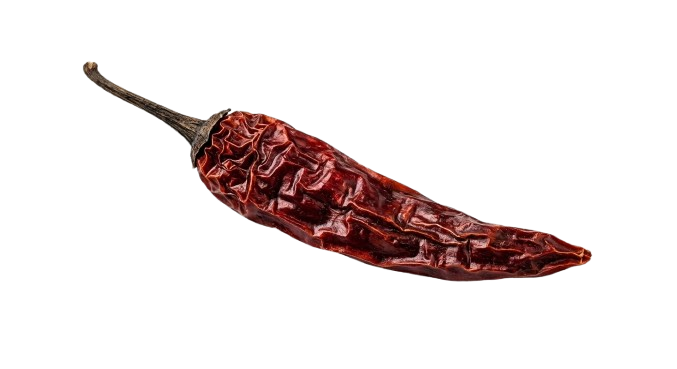
The benchmark hot chilli of the Indian trade. Grown across the black-cotton belt of Guntur and Prakasam, Sannam S4 carries the heat that Korean, Sri Lankan and Middle Eastern kitchens build around.
350,000
Scoville, top of range
- Botanical name
- Capsicum annuum
- Known as
- Sannam S4గుంటూరు మిరపకాయ
- Origin
- Guntur & Prakasam districts
- Harvest
- December – April

Guntur is not a growing region so much as a price signal. The chillies that leave its yards set the reference against which every other Indian hot chilli is quoted, and the S4 Sannam type is the one buyers name by default. Around 280,000 tonnes of it move in a normal year.
The pungency band across Guntur types is wide — anywhere from 30,000 to 350,000 Scoville Heat Units depending on the type, the season and where in the field the pod grew. Sannam S4 sits in the hot end of that range while still holding an ASTA colour value of 50–80, which is why it works as both a heat source and a colouring chilli in a single lot.
Cultivation runs beyond the district line into Warangal and Khammam in Telangana. From there it ships to Sri Lanka, Bangladesh, the Middle East, South Korea, the United Kingdom, the United States and Latin America — a spread of destinations that no other Indian chilli matches.
Deep black-cotton soils that hold the post-monsoon moisture, followed by a long dry ripening window. The pod stays on the plant until the colour has set hard, which is what gives Guntur chilli its shelf-stable red.
GI tagged
Guntur Sannam chilli is registered under India's Geographical Indications regime.
Measured
- Pungency (Guntur types)
- 30,000 – 350,000 SHU
- ASTA colour value
- 50 – 80
- Annual volume, S4 type
- ≈ 280,000 tonnes
- Moisture
- ≤ 11%
Grades we ship
- SANNAM S4
The export standard. Long, smooth, deep red pod.
- 334
Premium export selection, tighter size band.
- TEJA
The high-heat type, drawn on for oleoresin and hot blends.
- 273
The common wrinkled pod, colour-forward.
Harvest window
- January — in harvest
- February — in harvest
- March — in harvest
- April — in harvest
- May — out of season
- June — out of season
- July — out of season
- August — out of season
- September — out of season
- October — out of season
- November — out of season
- December — in harvest
December – April
Contracts placed against a coming harvest are priced at the yard once the crop lands, not before.
Forms
- Whole with stem
- Stemless
- Crushed
- Powder
- Oleoresin feedstock
Ships to
 Sri Lanka
 Bangladesh
- Middle East
 South Korea
 United Kingdom
 United States
- Latin America